
You want to start a junk journal. You’ve watched the flip-throughs, saved forty pins, maybe bought a stack of pretty paper that’s still in its wrapper. And now you’re sitting in front of all of it, a little frozen, because everyone else’s looks finished and yours doesn’t exist yet.
Here’s the part nobody leads with. There’s no right way to start, and most of the “rules” you’re scared of breaking were invented by the algorithm. A junk journal is just a book you make out of saved paper and then put your life into. (I kept buying supplies I never opened, so I know the freeze.)
How to start junk journaling: gather a few sheets of paper you like (old book pages, an envelope, a receipt you’re sentimental about), fold them into a small stack, sew or glue that stack into a cover, and start gluing in the bits you’ve been saving. That’s it. You need almost nothing, most of it’s already in a drawer, and your first page is allowed to be ugly.

Why does starting a junk journal feel so hard?
Because most of what you’ve seen isn’t a beginner starting. It’s an experienced maker performing a finished thing. That Pinterest spread with the tea-stained pages and the seventeen coordinated ephemera tucks took someone years of practice to build. Your blank book isn’t behind. It just hasn’t been started yet.
The other reason: you’ve been told junk journaling is crafting, in the curated, look-how-organized-I-am sense. It isn’t. It’s closer to a diary that happens to be made of texture instead of just words. The goal was never a pretty object for other people to scroll past. The goal is a place to put a Tuesday. The ticket stub, the grocery list, the line your kid said that you don’t want to forget.
When you swap “make it pretty” for “make it true,” the freeze tends to lift. You’re not auditioning. You’re documenting being alive. (Mine has a page that’s just a coffee ring and a receipt. It’s one of my favorites.)
There’s a quieter reason too, worth saying plainly: somewhere along the way, “making something” started to mean “making something other people would admire.” A junk journal gently refuses that. It’s closer to a diary with texture than a craft project, and the only audience that matters is future-you, flipping back through it on an ordinary Wednesday. Once you let it be for you, the page stops being a performance and becomes a place to land.
What do you actually need to start a junk journal?
Less than the haul videos suggest. Here’s the honest starter list, the five things and what you can skip.
- Paper to make pages. Old book pages, brown paper bags, sheet music, envelopes, the blank backs of junk mail. Anything with a bit of age or texture beats fresh printer paper. These become your signatures (the little folded stacks).
- Something to bind it. A needle and waxed thread, or just a stapler, or even binder rings. Three holes and some string holds a book together fine for your first one.
- A cover. A cereal box, a sturdy old book you gut, a piece of chipboard. It only has to be stiffer than the pages.
- Glue. A glue stick gets you going. A bottle of PVA (the white craft glue) lasts longer and holds heavier bits. That’s the whole adhesive aisle, demystified.
- Stuff to put in it. Ribbon scraps, washi, stamps, tags, a photo, a pressed flower, the paper sleeve from a tea bag. Your “stuff” is whatever you’ve been quietly unable to throw away.
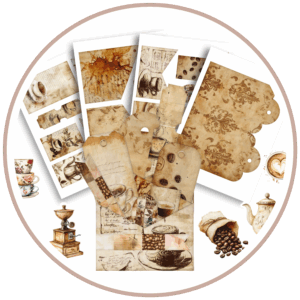
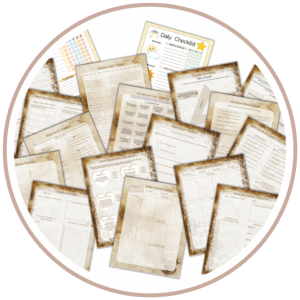
What you can skip on day one: a die-cut machine, a heat gun, distress inks, a $40 ephemera bundle. You can add those later if you fall in love with it. Plenty of makers never buy them at all. And if the gathering is itself the thing stopping you, that’s exactly what a curated junk journal kit solves. The deciding is done, the vintage feel is built in, and you skip straight to the making.
You don’t need a base book at all, by the way. One of the most loved ways in is to make a junk journal from an old book you already own.
A word on the gathering, because it’s secretly the best part. You already own most of this. The “junk” is the paper you couldn’t quite recycle, the ribbon off a gift, the ticket still in your coat pocket, the soft-covered book in the donate pile. Walk through your house once with new eyes and you’ll have a pile before you’ve spent a dollar. And if the gathering is the thing that stalls you, that’s exactly what a curated kit solves, the deciding is done and the vintage feel is built in, so you skip straight to the making.

How do you make your first junk journal, step by step?
Here’s the whole thing, start to finish, in an afternoon.
- Make 2 or 3 signatures. Take 4 or 5 sheets, fold each in half, nest them into little stacks. Each stack is a signature.
- Make the cover. Cut your chipboard or cereal box slightly bigger than a folded page, front and back. Cover it with paper or fabric if you want, or leave it raw.
- Bind it. Line the signatures up inside the cover, poke 3 to 5 holes down the fold, and sew through with a pamphlet stitch. Or staple. Or ring it. Done is the goal, not perfect.
- Add the pockets and tucks. Glue an envelope onto a page for a pocket. Fold a page edge up and glue the sides for a tuck spot. Now you have somewhere to slip things.
- Put one real thing on one page. Not the whole book. One page. A photo, a ticket, today’s grocery list. Glue it down. That’s a finished page, and you are now junk journaling.
The first page is the hardest because it’s the one where you’re still trying to make it good. Make it bad on purpose if you have to. The book loosens up after that. And once you’ve got the bones, the only question left is what to actually put on the pages, which is the fun part. (I work on mine with a toddler on my hip half the time. It still counts.)
Key Takeaways
- Junk journaling is documentation, not decoration. You’re saving a life, not staging a photo.
- You need five things: page paper, a binding, a cover, glue, and saved bits. Most of it’s already in your house.
- Skip the expensive gadgets on day one. Add them only if you fall in love.
- A pamphlet stitch (or a stapler) binds your first book just fine.
- Your first page is allowed to be ugly. Make it bad on purpose to break the freeze.

What if your first one is ugly?
Then it’s working. The first page is the hardest because it’s the one where you’re still trying to make it good, and good is the enemy here. Glue something down crooked on purpose. Use the cheap glue stick. Let an edge fray. A junk journal that looks a little wrecked is one that’s actually being used, and the pristine ones are almost always the abandoned ones.
Mine doesn’t look like the flip-throughs. It’s a fat, water-stained hardcover with the seam binding fraying at the spine, a coffee ring on page three, and a grocery list glued in crooked next to a pressed dandelion my daughter handed me on a walk. It smells faintly of old paper and the cinnamon candle I keep lit while I work. None of it is impressive. All of it is mine. That’s the whole thing.
Do you really have time for this?
More than you think, because it doesn’t happen in one sitting. The first signatures and the cover are maybe twenty minutes. After that, the book is the rare project that’s genuinely fine with being picked up and put down. You can add one thing in the five minutes before the coffee goes cold, while a toddler is deep in a show, in the soft quiet after bedtime. It waits for you. There’s no streak to keep and no week you fell behind on.
And the low bar is the whole strategy. One true thing on one page is a finished entry. A coffee ring and a date counts. A page a week still becomes a full book by spring. The goal was never a beautiful object to show people. It was a place to keep an ordinary life that goes by faster than anyone warns you.
So where do you go once it’s built?
The book is the hard part, and you just did it. The rest is the fun part, and you don’t have to figure it out alone. If you’re staring at the empty pages wondering what actually goes inside, here’s what to put in a junk journal, the keepsakes and the building blocks and where to tuck them. When a page is made and you’re not sure what to write, that has its own gentle answer: what to write in a junk journal, and the short version is whatever you’d otherwise lose. If a small voice keeps insisting this is really just scrapbooking and you’re doing it wrong, you’re not, and junk journal vs scrapbook untangles the two. And if building a book from scratch is the part that froze you in the first place, you can skip it entirely and make a junk journal from a book you already own.
And if you’re still circling the very start, two more gentle on-ramps: what a junk journal actually is if the whole idea still feels fuzzy, and junk journal ideas for beginners when you just want a few easy first pages to copy.
Frequently Asked Questions
What do I need to start junk journaling?
Five things: paper for pages (old book pages, envelopes, bags), something to bind with (thread, staples, or rings), a stiff cover, glue, and a handful of saved ephemera. You can start with what’s already in a drawer, no special machine required.
Is junk journaling expensive to start?
No. The starter version costs close to nothing because the “junk” is paper you’d otherwise recycle. A curated kit is worth it when you’d rather skip the sourcing and start making right away, but it’s a convenience, not a requirement.
What’s the difference between a junk journal and a scrapbook?
A scrapbook tends to document events in a finished, organized way. A junk journal is looser, layered, and ongoing, more like a textured diary. There’s a fuller answer in junk journal vs scrapbook, but the short version: a scrapbook performs the memory, a junk journal just keeps it.
How many pages should my first junk journal have?
Start small, 2 or 3 signatures (roughly 8 to 12 pages). A short book you finish beats a thick one that intimidates you. You can always bind another.



0 Comments